Were our ancient ancestors fish?
Watching a goldfish swim around its bowl, you probably don’tthink: that’s family! But surprisingly, in a distant way, it kind of is. Curious how that’s possible?
Out of the sea
To find the answer, we’ll need to rewind the clock – way back, nearly 400 million years. The world then was very different from today. No animals with bones had set foot on land yet. Bony animals lived only in the sea. These creatures are what we call vertebrates.
Fast forward to today, and vertebrates are everywhere on land – from tiny mice to huge elephants, from tigers to us humans. So at some point, hundreds of millions of years ago, vertebrates must have crawled out of the water and onto dry land.
Fish that could walk
It wasn’t a sudden leap. Somewhere in the ancient shallows, there must have been a fish whose fins slowly developed to become more leg-like. As time passed, its gills also transformed into simple lungs, allowing it to breathe air.
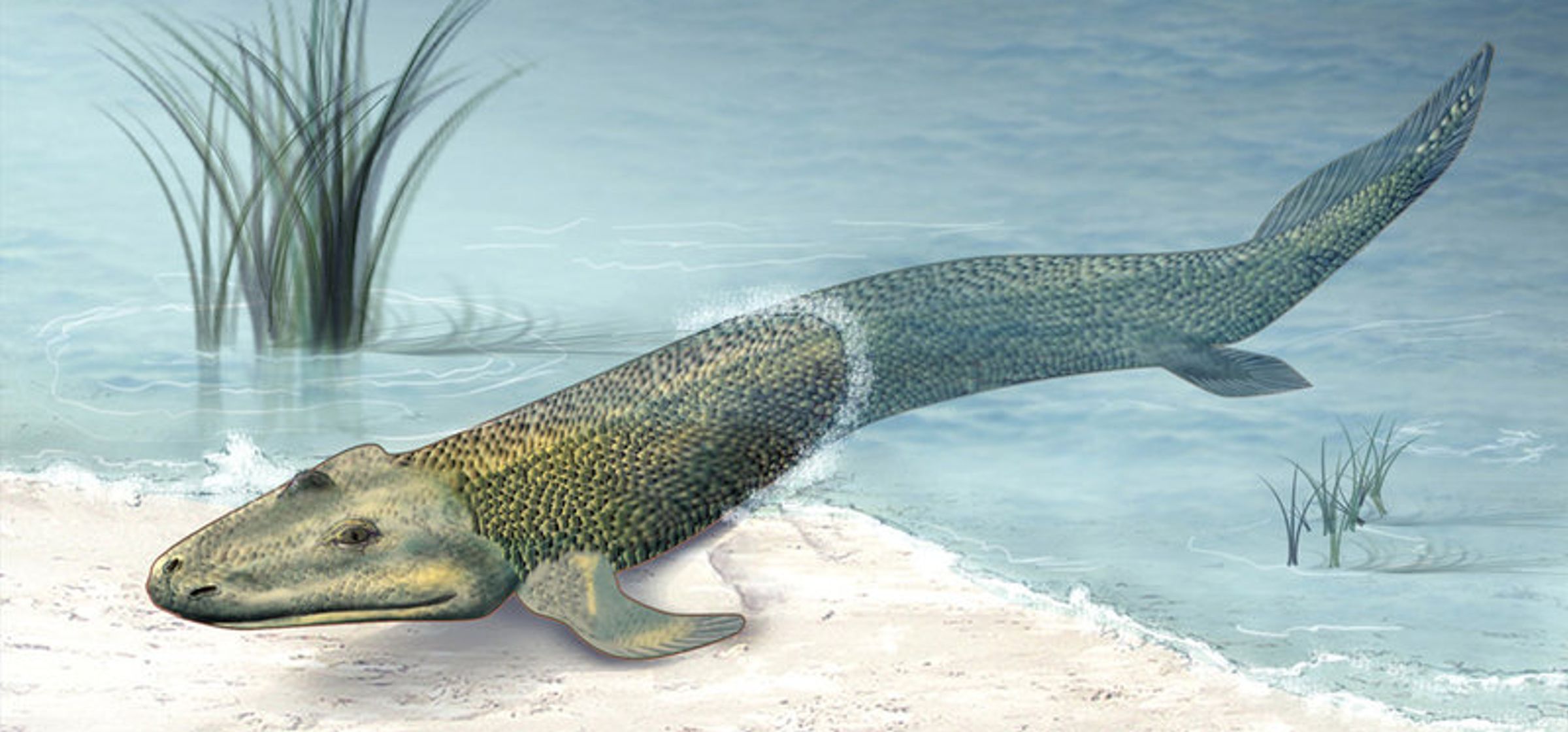
A few years ago, researchers found the remains of a remarkable fish called Tiktaalik, which swam the Earth’s waters roughly 375 million years ago. (See illustration above.) Inside its fins were bones that looked surprisingly like fingers, arms and elbows – just the things it would need to make the first steps onto land.
More and more groups
Tiktaalik was among the earliest known members of a group of fish known as lobe-finned fish. Over time, this group gave rise to more and more groups and many of the animals we know today, such as amphibians (frogs), reptiles (snakes), birds and mammals.
We too are mammals! And if you trace our family tree back far enough, you’ll find we share an ancestor with that little goldfish in the bowl. So it’s true – we’re distant relatives!
Answered by Naomi Vreeburg