Go to main content

Brain Art

Your brain plays a role in everything you do. It controls what you think, feel, and do. It helps you understand the world around you, even when you’re not aware of it. The entrance hall of NEMO is housing a temporary exhibition featuring artworks full of surprising facts about the brain.

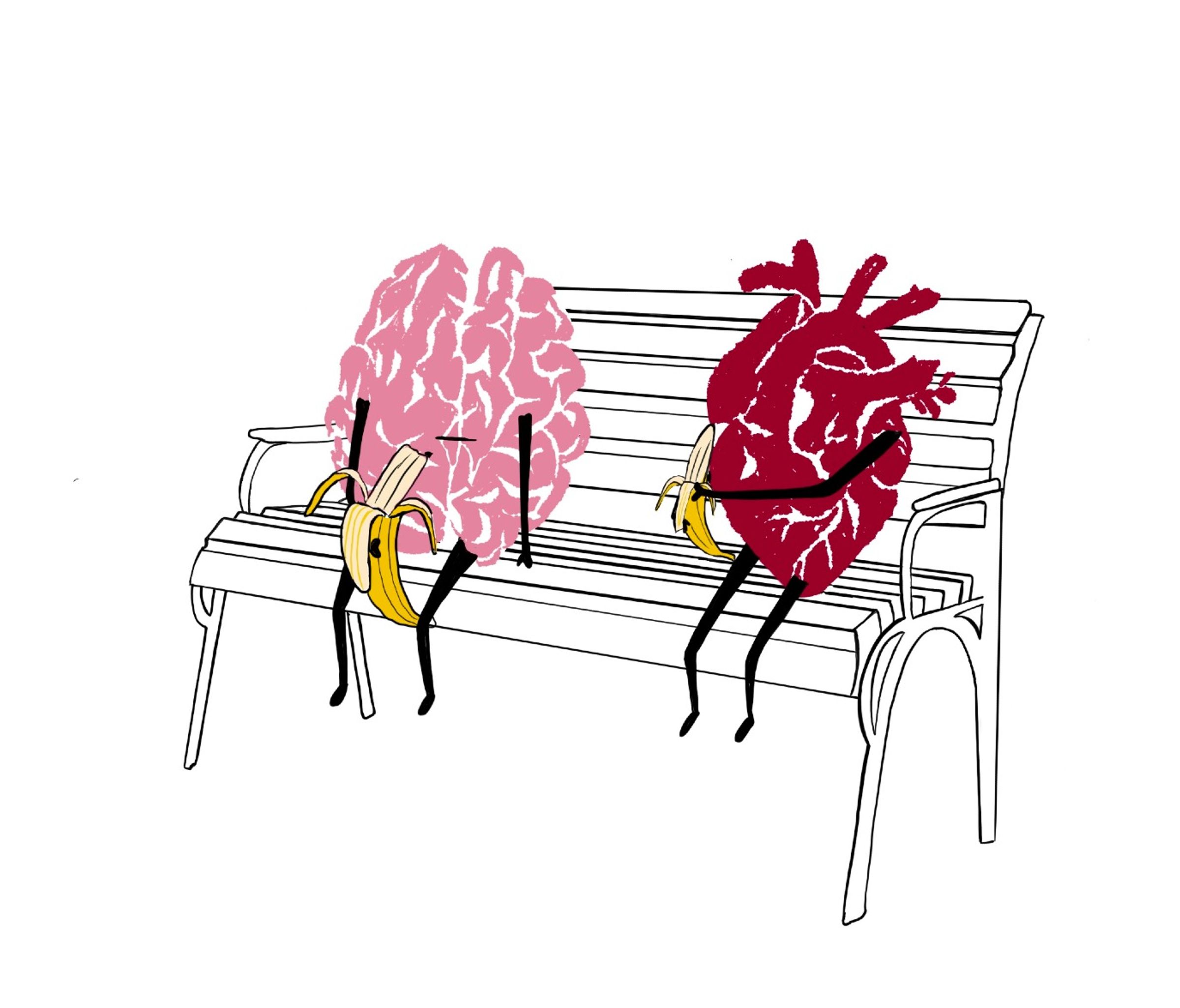
illustration of a brain and a heart sitting on a bench eating a banana

Facts about the brain

These artworks featuring facts about the brain were developed by Wetenschap op Woensdag, a collaboration between the University Medical Center Groningen, the University of Groningen, BCN, and Academie Minerva, with funding from the KNAW. The informational texts were written by the University Museum Groningen. On this page, you can read more background information about the brain facts.

Cortex of women

The cortex of women contains 16% fewer neurons.

Yet, women are not less intelligent. Their neurons have on average more connections. Also, their brain tissue has a higher metabolism, which might best be compared to an engine running at higher revolutions.

Positive thinking

Those who think more positively about themselves are better equipped to handle stress and depression.

People who have experienced depression and undergo psychotherapy have a lower risk of relapse. This is partly because preventive treatment helps them develop a more positive self-image, as discovered by brain researchers at the UMCG.

The pill

The pill does not cause depression.

Young women who start using the pill have depression slightly more often than women who do not. Still, you cannot simply say that this is caused by the pill. Other factors also play a role among women who use the pill, such as having a first sexual relationship.

Hearing problems

Hearing problems can lead to hearing sounds that aren't really there.

For our perception, we use information from our senses. If the brain receives little information from the outside, it fills in the gaps itself using our expectations. We then hear things that are not there: we start to hallucinate. In people with hearing problems, less information comes from the senses, so they hallucinate more as well.

Extra hemisphere of the brain

Left-handed individuals sometimes use an extra hemisphere of the brain.

Recognizing faces usually takes place in the right hemisphere of the brain. However, in left-handed people this sometimes works a bit differently. Research shows that some left-handed individuals use not one, but both hemispheres when they look at a face.

Difference hemispheres of the brain

The left hemisphere processes words and details, while the right recognizes faces.

The two hemispheres of the brain look similar, but each has its own specializations. In most people, for example, the right hemisphere is an expert at recognizing faces. However, in five percent of right-handed people and in a third of left-handed people this is reversed. There is also a group that uses both hemispheres.

Fecal transplant

In the future, psychiatric disorders might be treatable with a fecal transplant.

Fecal transplants as a treatment for psychiatric disorders? In recent years, more and more research has been done on this. In a fecal transplant, people receive stool from a donor with healthy gut bacteria. A small study showed that fecal transplants had a positive effect on the social skills of people with autism.

The experience of time

The experience of time is an illusion of consciousness.

The brain has a 24-hour clock for your day–night rhythm. This ensures that you become sleepy in the evening and wake up in the morning. But where does the experience of everyday time come from, such as the time until your bus arrives? There is no separate sense for time. What trick does consciousness use?

Handymen

Microglia cells are the handymen of the brain.

Your brain has different types of cells, such as microglia. Wherever there are problems in the brain, microglial cells appear to address them. They clean up waste, remove intruders, and repair cells. Once the task is completed, they store it in their memory and become better at that task.

Medication

Medications travel through the blood and randomly reach the right place.

Medications that you take orally travel through the bloodstream throughout the body. They do not go directly to their target but reach it by chance. Because medications spread throughout your body, they can also cause various side effects in other parts of the body and even affect your behavior.

Dilated pupils

When you see someone you know, your pupil grows a little bigger for half a second.

Your pupils dilate when you see someone you know because your brain considers this person important. The size of your pupils shows how much your brain is processing or how emotionally involved you are, even though you may not be aware of it.

Chocolate

Looking for someone in the crowd? Eating dark chocolate will help you find them faster.

Chocolate contains a nutrient called flavanols, which make you search more efficiently. A study from Groningen showed that 50 students were faster in finding figures on a screen if they had just drank chocolate milk containing flavanols, compared to when they had drank chocolate milk without this antioxidant.

Risky driving

When drivers feel safe, they take more risks.

Traffic experts take this into account to promote safe driving behavior. For example, a new driver-assistance system should not cause people to take more risks, even if they feel safer. Sometimes, feeling unsafe can actually make people drive more carefully.

Focus

Everyone can multitask. What’s really hard is focusing on just one thing.

In most cases, multitasking works just fine. Because a lot of attention is given to the rare cases where multitasking goes wrong, the impression has arisen that people are not good at it. In these situations, however, the focus is not on doing the right task at the right time.

Head and heart

What's good for your heart, is good for your brain.

People with a higher risk of cardiovascular disorders are also at greater risk of developing dementia. With a healthy heart, you decrease the risk of dementia. A healthy lifestyle, such as not smoking or drinking alcohol, will benefit not only a healthy heart, but also a healthy brain.

A foreign language

In a foreign language, people make more logical decisions.

When people think about a difficult question in a foreign language, they are often less affected by emotions. This helps them make more logical decisions, even if the choice is morally hard.

Allergy & hallucination

People with asthma, eczema, or allergic rhinitis hallucinate more often.

People with schizophrenia are more likely to have asthma, eczema, or hay fever. Even people without psychosis, who sometimes experience things like hallucinations, are more likely to have allergies such as asthma, eczema, and hay fever. This suggests a connection between the immune system and the development of psychotic experiences.

Mental effort

Mental effort causes the pupil to dilate.

Your pupils grow bigger when you have to think a lot or work hard on a task. This happens because mental effort causes a physical response in your body. Scientists use the size of your pupils to measure how much effort you're putting into a task.

The longest cells

Neurons that control our muscles are the longest cells in the human body.

Our body is controlled by our brains. Our brains send signals to the muscles so they come into action. Such a signal will travel via neurons through the body. Neurons that control muscles are called motor neurons. One motor neuron can be up to 1.5 metres long, from your spine to toes.

Drifting off

We mind-wander almost half of the time.

When people have to do a boring task, they drift off with their thoughts about half of the time. This was shown in an experiment where people were asked every minute what they were thinking about. It shows how often we mind wander while doing something.

Last minute

Last-minute studying leads to a higher grade.

Studying at the last minute can get you a higher grade, but the downside is that you'll forget the information quickly. Studying over several days or weeks helps you remember the material for a much longer time.

Newborn rat

The brain of a human fetus in the middle of pregnancy looks like that of a newborn rat.

Rats develop their brains in different stages, both during pregnancy and after birth. Because the brains of newborn rats resemble those of a human fetus, scientists can use rat brains for research. This allows them to study how medications during pregnancy affect the brain development of the human fetus.

Einstein's brain

Einstein’s brain had an anomaly in the area important for processing numbers.

Einstein's brain was malformed in the area responsible for processing numbers, called the Sylvian Fissure. This area was 15% wider than average, which may have contributed to his exceptional math skills.

Neuron clock

Most neurons in the brain have their own lock, which determines how you feel and behave.

Most cells have their own clock, including brain cells, which can change the cell’s behavior throughout the day. The biological clock in the hypothalamus ensures that all clocks are aligned with the sleep–wake rhythm. As a result, our mood depends on the time of day.

Vibrations

Regular, light vibrations can make your brain perform better.

The vibrations stimulate the brain and help you perform better on a cognitive test. Researchers noticed this especially with the Stroop test, where you have to read color words that are printed in a different color. This brain stimulation could be beneficial for people who use a wheelchair.

Stress

Stress for an exam week changes the composition of bacteria in your gut.

Research shows that the number of lactic acid bacteria decreased in students during their exam week. These changes in the gut are possibly partly related to stress-related changes in eating habits, with less vegetables and more caffeine.

Verbal fluency test

How many animals can you name in 1 minute? This test is used to detect language problems, dementia, and brain damage.

In the verbal fluency test, you have 60 seconds to name as many animals as possible. This test measures how well the brain can retrieve information from memory. It is used to detect language difficulties that can occur in conditions like dementia, language disorders, and brain injuries.

Sleep rhythm

Newborn babies sleep up to 80% of the time.

Newborn babies sleep day and night without a clear sleep rhythm. This is because their biological clock still needs to develop. A lot of sleep is needed for this during the first two years of life. As we get older, the biological clock starts to work less efficiently, and the day–night rhythm gradually fades.

Imaginary friends

Many children have imaginary friends that they can see, but don't really exist.

These little friends can be anything: people, animals, or even imaginary creatures. It is normal for children to have such friends, and they help with their development. These imaginary friends can help children process emotions, practice social skills, and learn how to solve problems.

Warmth and sense of time

When you're warm, time feels like it passes faster.

When your body temperature rises, time seems to pass faster. You also make decisions more quickly. As a result, you have less time to process information and consider fewer options. The consequence: more rash decisions. This likely helps explain why there is more street violence on summer evenings.